You design the future. We help you make it happen.
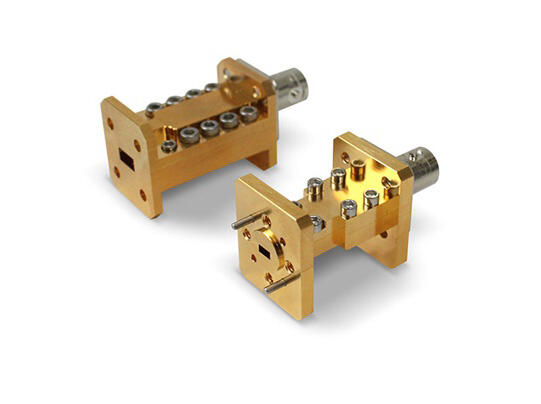
Maury MW - Calibrated Noise Sources - NC5000A Series
- Outstanding stability
- Fast switching speed
- Ripple-free response over standard waveguide bands
The NC5000A Series AWGN noise sources feature outstanding stability, switching speed, and ripple-free response over standard waveguide bands. The high stability of the NC5000A Series allows these units to be used in place of cumbersome gas tube noise sources.
Ripple in the output of noise sources has a direct effect on measurement accuracy, so Noisecom has tailored the response of the NC5000A Series so that ripple is minimized throughout the specified frequency range.
|
Noise Output Rise and Fall Times |
Noise Output Variation with Temperature |
Noise Output Variation with Voltage |
Operating Temperature |
Input Power |
|---|---|---|---|---|
|
Less than 1 μs |
Less than 0.01 dB/°C |
Less than 0.1 dB/1 % ΔV |
0 to +85°C | +28 VDC at 30 mA max |
Options
- NC5opt01 +15 VDC
- NC5opt04 +28 VDC with regulation; Stabilized noise output for ±2V variation
- NC5opt05 Output isolator
Applications
- Noise figure measurement
- Built-in test equipment (bite)
- Automotive Radar
- Radiometers
- Military applications
- 802.11ad, 60GHz Wi-Fi
- 60 GHz WiGig
- Small Cell Wireless Backhaul
- Wireless HD
More Product Information
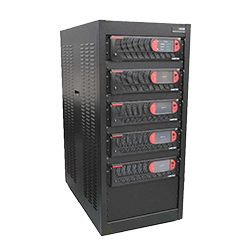
- High DC power density up to 150 kW in a single bay rack-mount cabinet. Up to 240 kW in a dual bay rack.
- Fast load transient response provides protection from undesired voltage excursions.
- Fast slew rate with exceptional rise/fall times for speed-critical applications.
- Low ripple suitable for the most sensitive applications.
- Low audible noise with temperature controlled variable speed fans.
- High accuracy voltage/current measurements without external DMMs.
- Modular architecture simplifies sparing and maintenance.
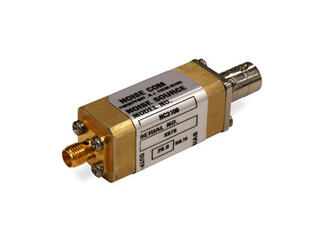
- Excellent temperature and voltage stability
- Units for noise figure meters feature 15.5-dB ± 0.75 dB ENR output
- High-output units for radar and satellite communications system testing feature output between 26 and 35 dB ± 1 dB ENR
The NC3000 Series calibrated coaxial AWGN sources are well suited for receiver testing, noise figure measurements, or applications that require broadband noise and fast switching times. Several models include output isolators, and voltage regulators that provide excellent stability over varying temperature and voltage ranges. The NC3000 Series includes the NC3100 units with 15 dB ENR output for noise-figure meters, and the NC3200 Series high-output noise sources with outputs between 26 and 35 dB ENR for radar and satellite communications system testing.
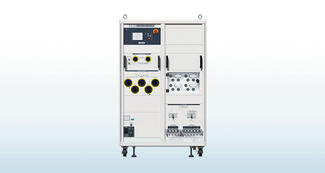
- Compliant with IEC 61000-4-5 Ed.3 standard:ECE R10 is regulated at Ed.2, possible to switch to Ed.2
- AC500V/200A DC600V/200A built-in coupling decoupling network.
- Built-in EV relay welding protection diode in DC line. You can evaluate the lightning surge resistance when charging EV / PHV vehicles, which is required by ECE R10-04 / 05. (EV Fast Charging applicable)
- Maximum output voltage 15kV: In the reliability evaluation test of the lightning surge test, the evaluation including the destructive test can be performed.
- Adopt a large LCD screen operation panel: A large LCD panel screen has been adopted for the operation unit to improve visibility and operability.
- Employs MPU control that simplifies continuous testing: Surge output / waveform switching / polarity switching / sequence operation can be performed automatically.
- Equipped with manual and program modes. Manual mode for standard tests and single condition tests, and Program mode for continuous tests under different conditions. You can easily set test conditions according to your application.
- Excellent safety functions including interlock
- Equipped with waveform check terminal as standard
- You can check the output waveform with your oscilloscope and BNC cable.
- Isolation transformer required to protect the power supply for EUT is available. (option)
- Possible to switch the constant of the decoupling circuit in order to prevent resonance with the power supply.
- Possible to switch to a circuit not including 18uF in the surge output of IEC61000-4-5 Edition 2.0 2005 version).
* This product is a custom product. Please contact us for details.
Customization up to DC1000V is available.
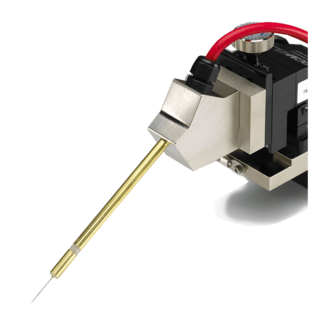
- Coaxial and triaxial measurements up to 10,000 V
- High-quality construction with low-noise electrical performance
- Replaceable probe tips in a variety of tip sizes
- Temperature range of of -60°C to 300°C
- Triaxial measurement ensures a much better understanding of device leakage in the off state
- Highly reliable, stable and repeatable measurements
- Integrally designed as part of a complete measurement solution
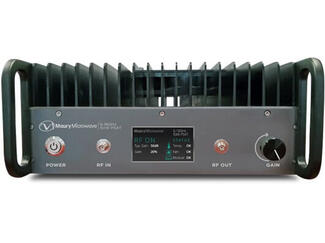
Not all amplifiers are created equal, so how can you be certain that an amplifier will work for your needs? You deserve to be confident that the amplifiers used with your test-and measurement lab benches will meet the requirements of your specific applications, are reliable, and are equally well-supported pre-and post-sale. When it comes to application expertise, reliability and support, there is no company that does it better than Maury.
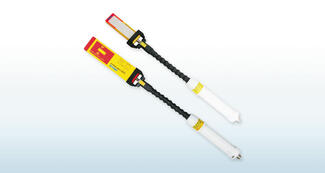
Thin plate broadband antenna has been developed for efficient immunity testing against hand-held transmitters and cellular phones. Many pieces of spot frequency antennas had to be used in turn thus fur. This new Thin-plate Broadband Antenna is a single antenna solution eliminating the need for antenna changes and dramatically reducing the test time. Furthermore, this antenna with its small-size and lightweight properties and a flexible handle is suitable for testing in narrow spaces.
-
A wide frequency range eliminating the need for antenna changes
-
30W maximum power input allows high filed strengths
-
High efficiency due to a low VSWR and high gain
-
Suitable for broadband digital modulation thanks to a good VSWR flatness
-
Small, light-weight and flat antenna easy to use in narrow spaces
-
Easy handling with a flexible arm
-
A wide radiation pattern makes directivity of the fields no longer an issue
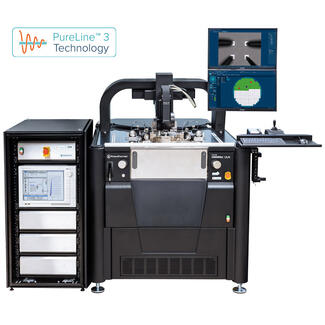
PureLine 3 Technology
- Provides an effectively noise free environment around the device under test (DUT)
- First automated probe station to achieve -190dB spectral noise*
- Up to 32x lower noise (1kHz), for improved device characterization and modelling at the 7/5/2 nm technology nodes targeted for 5G and beyond applications
- Eliminates over 97% of the environmental noise experienced in previous probe systems
- Extensive collection of FormFactor patents, electrical design knowledge, and measurement system IP
Plug In and Go
- World’s first probe station with integrated TestCell Power Management (a TestCell is a connected set of equipment, including test software, instruments, probe station, thermal system, and related measurement accessories such as cables and on-wafer probes)
- Eliminates all ground-loop induced TestCell noise
- Low field emissions
- Provides fully managed and filtered AC power to the entire system, prober and instruments
See "Specifications & Details" tab for more key features
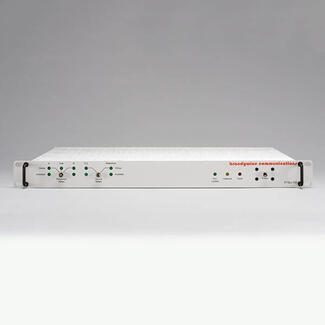
- Network Enabled Distribution Amplifier
- Low Phase Noise Reference Frequency Outputs
- Fault Alarm Output
- 1U 19″ Rack Mount
- Frequency Synthesizer Option
- Hitless Switching of Reference
- Programmable Amplitude
- Propagation Delay Compensation
- 10 MHz Standard, Other Frequencies Available
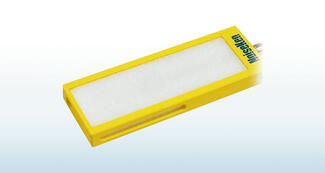
The Broadband sleeve antenna was developed to efficiently perform proximity radiation immunity testing.
The international standards ISO11451-3/ISO11452-9 stipulate proximity radiation immunity testing methods that assume electromagnetic interference when wireless transmitters such as smartphones and Wi-Fi devices are placed in close proximity to other electronic devices.
This product is a small, lightweight, high-gain antenna used in these standards that covers a wide bandwidth and has good radiation characteristics. Since it can be used in the wide band from 5GHz to 8GHz, it can be used to perform proximity radiation immunity testing assuming wireless LAN in the 6GHz band (up to 7.125GHz).

Maury Microwave
Website
Maury Microwave is a pioneering leader in the design and manufacture of precision RF and Microwave calibration, test & measurement, and modeling solutions that are powering global efforts toward a more secure, more connected, future.
Maury Microwave offers Measurement and Modeling Device Characterization Systems and Services including nonlinear passive, active and hybrid-active fundamental and harmonic load pull, non-50Ω X-Parameter modeling, pulsed IV Pulsed s-parameters and compact transistor modeling, and patent-pending ultra-fast/accurate noise parameters.