You design the future. We help you make it happen.
Southwest Microwave - TNC Connectors 18 GHz
See "Specifications & Details" tab for more information.
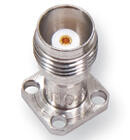
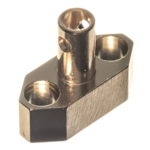
TNC Jack (Female) 4 Hole .500 Square
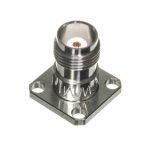
TNC Jack (Female) 4 Hole .687 Square
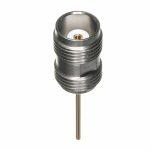
TNC Jack (Female) Thread-In Waveguide Probe
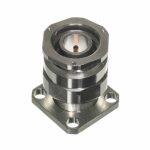
TNC Plug (Male) 4 Hole .687 Square
More Product Information
-
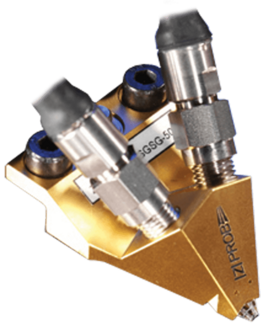
Best price per contact – typically over one million (1,000,000) touchdowns
-
RF/Microwave signal is shielded and completely air isolated in the probe body
-
Excellent performance in vacuum environments and temperatures as low as 4 K, or as high as 300°C
-
Highest impedance control with perfectly-symmetrical, MEMS-machined coplanar contact structure
-
Probe on any pad material with minimal damage
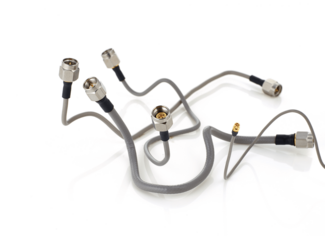
Coaxial cable assembly suitable for fixed wiring inside and between equipment used in the microwave band up to 100GHz (continuous operating temperature range: -30 to +85°C).
These cables have excellent formability (shape-retention capability) that make wiring work easy and exhibit superior loss characteristics compared to semi-rigid cables.
Standard connectors are SMA (m) straight connectors, although other connectors can be used as required.
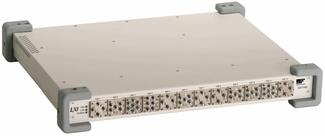
- Combine up to 12 fail-safe building blocks, dual SPDT, SP4T, SP6T, or transfer switch in a compact 1U footprint
- Front “pluggable” relays facilitate field maintenance
- Embedded web interface provides interactive utility to monitor and control relays from anywhere in the world
- Flexible API supports IVI and Linux development environments minimizing software investment
- LXI Trigger Event implementation provides seamless test synchronization with external devices
- Store up to 128 relay state configurations for quick recall, including an automatic power up state
- Define exclude lists to avoid setting an undesirable configuration
- Relay odometer tracks closures to facilitate preventative maintenance
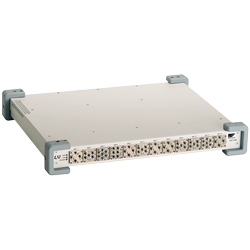
- Combine up to 12 fail-safe building blocks, dual SPDT, SP4T, SP6T, or transfer switch in a compact 1U footprint
- Front “pluggable” relays facilitate field maintenance
- Embedded web interface provides interactive utility to monitor and control relays from anywhere in the world
- Flexible API supports IVI and Linux development environments minimizing software investment
- LXI Trigger Event implementation provides seamless test synchronization with external devices
- Store up to 128 relay state configurations for quick recall, including an automatic power up state
- Define exclude lists to avoid setting an undesirable configuration
- Relay odometer tracks closures to facilitate preventative maintenance
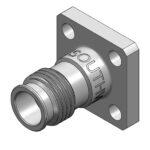
1.35 mm DC to 90 GHz connectors from Southwest Microwave include a field-replaceable 4-hole Flange-mount Connector, standard Thread-in Connector, Cable Connector, clamp-on solderless End Launch Connector, Solderless Vertical Launch Connector, and between series adaptors.
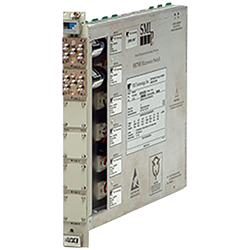
The SM7000 Series microwave switching modules are members of the VXI Technology SMIPII™ family. They offer a modular design allowing custom switching configurations to be easily assembled and modified in the field.
The SM7000 is a single-wide, C-size VXI module, which can support up to six different microwave switches including: a dual SPDT; SP3T through SP6T; transfer switches and passthrough adapters that allow the module to control up to eight externally mounted relays each.
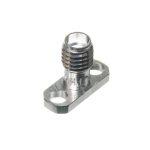
See "Specifications & Details" tab for more information.
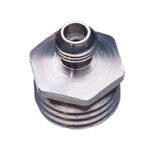
Introducing Southwest Microwave’s newest high-performance connector, the groundbreaking 0.8 mm (145 GHz) high-performance thread-in connector. This cutting-edge design ensures exceptional signal integrity while delivering the industry’s lowest VSWR, RF leakage, and insertion loss.
- Will mate with IEEE 287 & IEC 61169-64 standards
- DC to 145 GHz
- Field replaceable and reusable

Southwest Microwave
Website
Since 1981, Southwest Microwave has delivered performance-leading interconnect solutions currently available from DC to 110 GHz for hi-rel/space, defense, instrumentation, integrated-circuit and PCB evaluation applications. Built in the USA to rigorous performance and quality standards, Southwest Microwave connectors deliver the industry’s lowest RF leakage, insertion loss and VSWR.