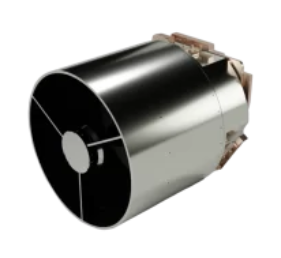
Safran DSI - SEEING™ 230 Ident High-Performance Optics
Acquire high quality images with accurate radiometry for LEO (Low Earth Observation) earth observation applications with 65 MP focal plane and control electronics. From a 500 km orbit, SEEING™ 230 Ident has 9 x 6 km2 swath, offering a 1.03m native Ground Sample Distance (GSD), and features a super-resolution optional mode providing 70cm GSD. Thanks to its unique design, SEEING™ 230 Ident has an ultra-low SWaP factor. It is made of advanced ceramic material for strength during launch and stability during operation in space. It is athermalized and gradient insensitive between -10°C to +50°C. It has a low mass, below 8kg, saving both platform and launch costs.
SEEING™ 230 Ident Features
|
Ultra Low Swap Factor |
Advanced ceramic material for strength during launch and stability during operation |
|---|---|
|
Light Weight |
Low mass, below 17.3 lbs (8 kg) |
|
High Resolution Optical Imager |
Includes a 65 Mpixels sensor and control electronics. |
More Product Information
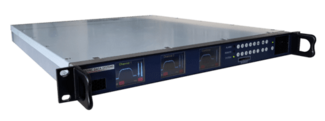
The CORTEX RTR-X1 (formerly RX-1) is a compact, dual-channel telemetry receiver with a pre-D combiner, designed to span all IRIG frequency bands and conform to IRIG-specified modulations.
This off-the-shelf (COTS) product leverages the rock-solid CORTEX RTR technology components, inheriting their renowned RF performance and signal processing prowess.
The RX-1 excels in test range scenarios, offering cutting-edge features to ensure maximum data accessibility. Trust the RX-1 for top-tier telemetry reception in challenging conditions.
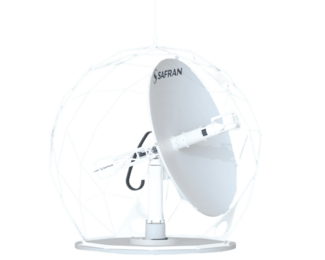
The LEGION 400 tackles the new challenges of the space industry, offering enhanced connectivity, faster delivery, improved value, and unrivaled flexibility.
This antenna system is designed to meet the demands of Earth Observation satellite tracking and the high-volume needs of Communication Satellite Constellations.
What sets the LEGION 400 apart is its patented tri-band S/X/Ka concentric feed paired with a sleek and ultra-precise pedestal. It’s equipped to support LEOP & Launch Vehicles with its cutting-edge S-band Single Channel Monopulse auto track feed.
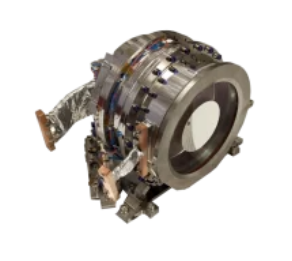
Safran’s SEEING™ 130 Wide includes a unique medium focal length catadioptric optics, limited by diffraction only and with ultra-low distortion, offering perfect imaging over 35 mm full-frame image format. It is fitted with a 10megapixel sensor.
SEEING™ 130 Wide enables high Signal to Noise Ratio for multispectral (MS), hyperspectral (HS) and low light level imaging. SEEING™ 130 Wide includes a spectral filter with 23 bands covering Blue, Green, Red, Near InfraRed and Red Edge MS, for a broad spectral range between 475 and 900nm. SEEING™ 130 Wide has a large Field of View of 6.3° x 4.3° / 54 x 36 km2 from a 500km/310 miles orbit.
In addition to its a thermal design within a robust structure, SEEING™ 130 Wide has a low SWaP, saving launch and operational costs.
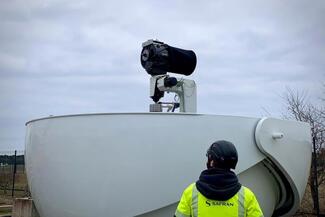
IRIS optical ground stations are built to cater to a wide range of applications (LEO/GEO/Probes), including Earth observation, high throughput bi-directional telecommunications, feeder link, or deep space missions. The IRIS systems leverage the Cortex Lasercom, a globally recognized optical modem that supports various standards such as SDA, CCSDS, and HPE.
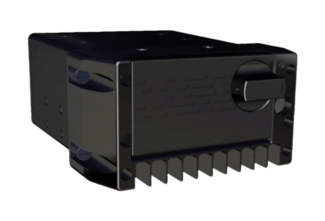
The NS1310 is a robust, compact data server and storage unit specifically designed for the challenging conditions of airborne environments.
This versatile system functions as a Network Attached Storage (NAS) unit and is equipped with a high-capacity Removable Memory Module (RMM).
The ENERTEC™ mission data processing and distribution units offer cost-effective and dependable solutions for field and mission data tasks, such as data acquisition, processing, storage, exploitation, and distribution. These units are suitable for use on both manned and unmanned ground, air, and sea vehicles. They undergo rigorous validation and formal qualification testing, adhering to standard test methods like DO-160 and MIL-STD-810.
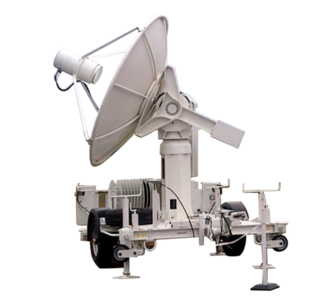
The SPARTE 300 series antenna is a battle-tested product that has consistently delivered top-tier performance for mission-critical applications where reliable telemetry reception is paramount. This rugged antenna guarantees our customers the utmost precision, a long operational life, and straightforward maintenance.
The SPARTE 300 series opens up a world of possibilities for users, ranging from aircraft tracking and high-speed target monitoring to duplex datalinks with both receiving and transmitting capabilities.
Furthermore, the extensive and customizable input/output options empower users to operate multiple antennas in a coordinated, multi-site tracking setup. With all antennas, regardless of size, being effortlessly monitored, managed and controlled by using our TM Maestro software.
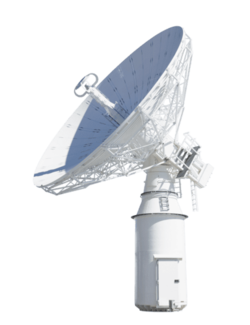
The SPARTE 900 series antenna stands as a testament to reliability and performance, tailored for mission-critical applications where telemetry reception is paramount. This field-proven product ensures accurate tracking of flying targets, such as aircraft or space launch vehicles, even at significant distances, thanks to its high gain and large aperture design.
The robust and durable construction of the SPARTE 900 series guarantees optimal performance in any scenario: an aluminum-alloy reflector for enhanced surface accuracy, SCM tracking feeds for dependable and precise tracking, and dual-drive motors for redundancy and no-backlash operation.
Additionally, the SPARTE 900 series comes equipped with a riser that integrates the Antenna Drive cabinet and any necessary equipment, allowing for optimal positioning in close proximity to the antenna.
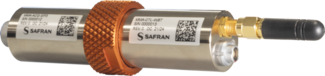
Sensors acquisition and recording for troubleshooting is a cumbersome process in a fully furnished or operational aircraft, especially when time and low footprint are key drivers.
This is no more the case with Safran new solution µMA:
- its cylindrical form factor allows easy installation by just requiring a standard clamp used to mount tubes
- its battery power supply and its wireless connectivity removes the need of installing any harness in the aircraft.
All these capabilities are available while providing high measuring performance and harsh environment ruggedized in line with Safran standard solutions.
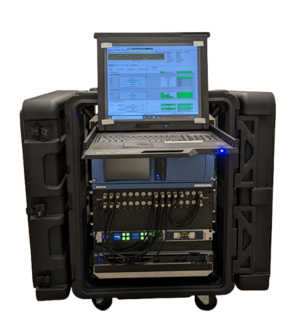
The Mobile Telemetry Rack (MTR) integrates state-of-the-art telemetry capabilities utilizing the RTR-X4 & GMDR recorder providing the ideal portable telemetry checkout system, able to receive demodulation, record, process and display your data throughout your system development.
Based on the Cortex architecture, the 4U chassis-based CORTEX RTR-X4 can support up to four channels providing the utmost flexibility and capability a Telemetry Receiver can achieve.
The GMDR Chapter 7 recorder fits particularly well for the flight test support where operability and flexibility is essential. Not only the does the Telemetry rack provide a rich set of features, the Dell Server comes with the standard Safran software tools you expect: D4 Recorder, C10 Extract, eZ Viewer Data Verification and Quick Look Software.
Additionally, multiple projects can be supported by just swapping out the OS & media drives in support of classified projects.
Safran DSI
Safran DSI Testing & Telemetry provides complete, end-to-end solutions covering instrumentation, mission systems, onboard recording, and transmission, through to base stations for data monitoring and control. Our solutions are platform-agnostic and adaptable to customer mission needs.