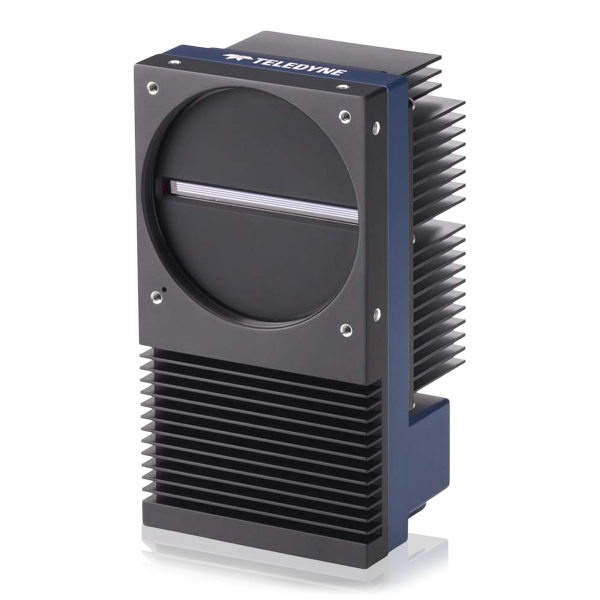
You design the future. We help you make it happen.
Teledyne DALSA - Linea HS2 16k 1MHz BSI Camera Series
- 1 MHz max line rate
- 65dB dynamic range
- Onchip 2x binning
- Mono/HDR/HFW
- Multi-arrays TDI
- Dual CLHS CX4 AOC output
Drawing on Teledyne’s four decades of industry leading expertise, the all new Linea™ HS2 camera series represents a significant breakthrough in next generation TDI technology. Designed for ultra-high-speed imaging in light starved conditions, it delivers exceptional image quality with 16k/5 µm resolution and boasts an industry leading maximum line rate of 1 Megahertz, or 16 Gigapixels per second data throughput.
Introducing The Future of Line Scan Imaging
The industry’s First 16K 1MHz TDI Camera: Teledyne DALSA’s new Linea HS2 camera represents another breakthrough in next generation TDI technology. Designed for ultra high speed imaging in light starved condition, this camera offers superior image quality with 16k resolution at a max line rate 1MHz. It has dual CLHS data interface that achieves 16GB/s data throughput with field-proven reliability in high-speed data transmission.
A Seamless Upgrade, Packed with Powerful Features
Linea HS2 offers an easy upgrade from Teledyne’s existing Linea HS line scan cameras, featuring the same pixel size, optics, cables, and mounting hardware, but with a 2.5 time increase in speed, while maintaining reasonable power consumption. The cameras also deliver the highest performance available, with unique features that significantly improve detectability for many demanding applications.
Backside Illumination for Ultra-High-Speed Imaging
Linea HS2 features a highly sensitive Backside Illuminated (BSI) multi-array charge-domain TDI CMOS sensor with 16k/5 µm resolution and optimized Quantum Efficiency, meeting the rigorous demands of current and future machine vision applications. The multi-array TDI sensor architecture allows the camera to be configured for superior image quality with maximized line rate, dynamic range, or full well, according to specific application requirements. On-chip binning also enables higher web speeds to boost system throughput. The camera is equipped with dual Camera Link HS CX4 connectors to Active Optical Cables providing complete EMI immunity.
A Complete Imaging Solution
For a complete solution, the Linea HS2 camera works with Teledyne’s Xtium3 CLHS series of high-performance frame grabbers, utilizing next generation CLHS technology. The Xtium3 CLHS PX8 is built on reliable, field-proven high-speed data transmission technology, delivering data at 16 Gigapixels per second over dual CLHS CX4 connectors to active optical cables. Its data forwarding capability supports parallel data processing in up to 12 PCs and together with Linea HS2, allows for cable lengths over 100 meters with complete EMI immunity.
Typical Applications
The Linea HS2 enables high speed and high sensitivity imaging in light starved conditions, making it particularly idea for:
- Semiconductor wafer inspection
- High density packaging inspection
- Flat panel display inspection
- Gene sequencing
- Digital pathology
If you need maximum throughput in the toughest conditions, you need Linea HS2.
Family Specifications
|
Camera Type |
TDI Line Scan |
|---|---|
|
Sensor Technology |
CMOS |
|
Supported Interfaces |
Camera Link HS |
|
Spectrum Capability |
Ultraviolet (350-400 nm), Visible (400-700 nm), Near Infrared (700-1000 nm) |
Specifications
|
Highlighted |
|
|---|---|
|
Part Number |
H2-HM-16K100H-00-B |
|
Resolution |
16384 x 288 (3 TDI arrays 128 + 128 + 32) |
|
Max Line Rate |
1000 kHz |
|
Sensor Model |
Teledyne DALSA |
|
Pixel Size |
5 |
|
Sensor Type |
CMOS |
|
Shutter type |
Time Delay Integration (TDI) |
|
Spectrum |
Mono |
|
Optical Filter |
None |
|
Lens Mount |
M90 x 1 mm |
|
Synchronization |
Image sync: Free-running, external trigger, CLHS trigger |
|
Data Interface |
Camera Link HS (CX4/A0C) |
|
Protection |
IP30 |
|
Recommended System Configuration |
|
|---|---|
|
Port |
CLHS 7 Data Lanes (10.3 Gbps/lane) |
|
Power Sourcing Equipment |
External Camera Power Supply |
|
Required Accessories |
Lens, Cable, Host Adapter (2x Xtium3-CLHS PX8 frame grabber pn: 0R-B8S0-PX870) |
|
Compliance & Certifications |
|
|---|---|
|
Compliance |
CE, FCC, KCC, RoHS, The ECCN for this product is: EAR099 |
|
Machine Vision Standard |
CameraLink HS v1.0 |
|
Warranty |
3 years |
|
Features |
|
|---|---|
|
Acquisition Modes |
Continuous |
|
Exposure Control |
Hardware trigger, programmable via camera API |
|
Exposure Range |
1 µs to 50 µs |
|
Flash Memory |
4 GB non-volatile memory |
|
Gain Control |
Manual |
|
Image Buffer |
N/A |
|
Image Processing |
Lookup table, Pixel correction and Flat line correction |
|
Partial Image Modes |
Pixel binning, ROI, Multi-ROI |
|
User Sets |
16 user configuration sets for custom camera settings |
|
Performance |
|
|---|---|
|
Dynamic Range dB |
65 |
|
Gain Range |
1x to 10x |
|
Peak Wavelength |
620 nm |
|
QE (Mono) |
Peak @ 620 nm |
|
Responsivity |
700+700+175 (DN8/nJ/cm2) |
|
Saturation Capacity (e-) |
30000 |
|
Temporal Dark Noise (Read Noise) |
< 2 DN |
|
Physical |
|
|---|---|
|
Connector |
CX4 or Hirose 12-pin circular (male) |
|
Digitization Bit Depth (ADC) |
8-bit, 10-bit |
|
Dimensions [W x H x L] |
97 mm x 180 mm x 76.9 mm |
|
Mass |
1.48 kg |
|
Operating Humidity |
15 to 85% (no condensation) |
|
Operating Temperature |
0°C to 50°C (measured at the front face of the camera) |
|
Power Consumption [Maximum] |
56 W |
|
Power Requirements |
24 V via GPIO connector |
|
Storage Humidity |
15 to 85% (no condensation) |
|
Storage Temperature |
-20°C to 80°C |
More Product Information
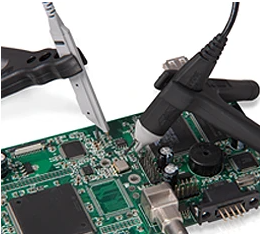
The ZS Series probes provide high impedance and an extensive set of probe tips and ground accessories to handle a wide range of probing scenarios. The high 1 MΩ input resistance and low 0.9 pF input capacitance means this probe is ideal for all frequencies. The ZS Series probes provide full system bandwidth with all Teledyne LeCroy oscilloscopes with bandwidths of 4 GHz and lower.
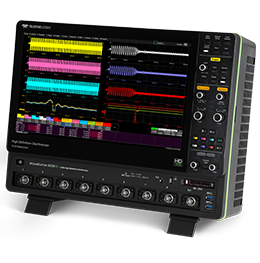
- Highest resolution – 12 bits all the time
- More channels, flexibility – 8 analog and 16 digital channels
- Longest Memory – 5 Gpt records with simple navigation – no compromise
- View 16 channels on one display with OscilloSYNC™
- Powerful, deep toolbox enables and simplifies complex analysis
- MAUI with OneTouch user interface for intuitive and efficient operation
- Zone Trigger – Simple Triggering for Complex Signals
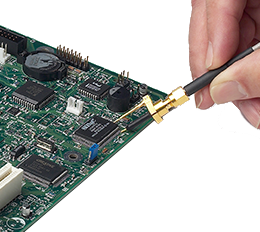
Transmission line probes are a special type of passive probe designed for use at very high frequencies. They replace the high impedance probe cable found in a traditional passive probe with a precision transmission line, with a characteristic impedance that matches the oscilloscope input (50 Ohm). This greatly reduces the input capacitance to a fraction of a picofarad, minimizing the loading of high frequency signals. A matching network at the tip increases the DC input resistance. While they have lower DC input resistance than a traditional passive probe (usually 500 Ohm) to 1kOhm), the input impedance of these probes remains nearly constant over their entire frequency range. A traditional /10 passive probe will have a 10 MOhm) input impedance at DC, however this impedance drops rapidly with frequency, passing below the input impedance of a transmission line probe at less than 100 MHz.
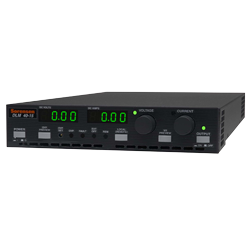
- High Power Density: 600 watts in 1U (1.75 inches) high, half rack (8.5 inches) wide; no top or bottom clearance spacing required.
- Near Linear Ripple & Noise Ripple as low as 2.5mV rms, noise as low as 15mV p-p.
- Remote Control
- LXI Compliant Ethernet LAN / RS-232C (16 bit)
- IEEE-488.2 / RS-232C (12 bit)
- Standard analog programming 0-5V, 0-10V, or 0-5kΩ.
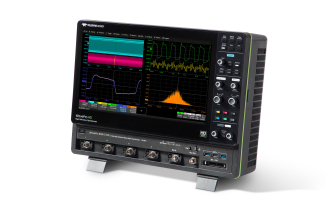
- HD4096 technology provides 12-bit resolution up to 8 GHz and 20 GS/s
- Up to 5 Gpts of acquisition memory enables detailed viewing of long events
- 15.6" 1900 x 1080 Full HD capacitive touchscreen
- New ProBus2 input supports up to 8 GHz bandwidth and direct compatibility with a wide variety of existing ProBus probes - 50Ω and 1MΩ coupling modes support all input types on a single connector
- MAUI with OneTouch user interface for intuitive and efficient operation
- Deep toolbox enables and simplifies complex analysis
- Intuitive navigation to quickly find important features in long waveforms
- Zone Trigger – Simple Triggering for Complex Signals
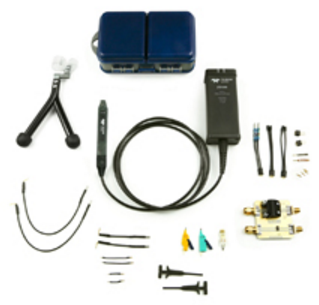
With the ProBus interface, the ZD500, 1000, and 1500 becomes an integral part of the oscilloscope. All probe gain and offset controls are transparent to the user, making it easier to probe the circuit without concern for which gain setting to choose. When used with a LeCroy digital oscilloscope, no external power supply is required.
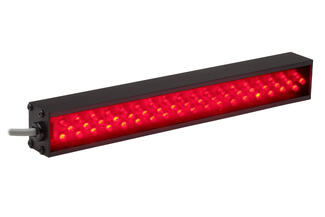
- Designed for machine vision applications that require broad illumination over a wide area with controlled fall off.
- This BALA (Broad Area Linear Array) bar light series is expandable in 1″ increments up to 82″.
- Applications requiring an even wider area of illumination can utilize two BALA bar lights aligned in parallel, facing each other.
- AL150 derivatives include AL4424 (4″), AL4554 (9″) and AL46120 (20″) (which represent legacy part numbers)

The EH1840 EMC horn combines stable gain performance and low VSWR with wide band frequency operation. The horn is single linearly polarized with excellent cross-polar discrimination. The unique horn design suppresses any possible excitation of higher order modes in the aperture and maintains a well-defined smooth radiation pattern in the direction of the boresight axis throughout the operational bandwidth.
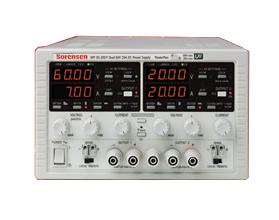
- PowerFlex design provides higher currents at lower voltages enabling one model to meet many different voltage/current requirements.
- Compact design for bench use or rack mounting (1/2 or 1/4 rack width)
- True analog controls with digital settings locking (S-Lock)
- Mixed-mode regulation with linear final regulation for low noise
- Dual models have isolated voltage tracking and synchronous on/off.
- P models have RS-232, USB, and LXI-compliant LAN interfaces plus duplicate rear terminals. GPIB Optional.

Teledyne DALSA
Teledyne DALSA is an international leader in high performance digital imaging and semiconductors with approximately 1000 employees world-wide. Established in 1980 and acquired by Teledyne Technologies in 2011, Teledyne DALSA designs, develops, manufactures, and markets digital imaging products and solutions, in addition to providing semiconductor products and services. Our core competencies are in specialized integrated circuit and electronics technology, software, and highly engineered semiconductor wafer processing.