You design the future. We help you make it happen.
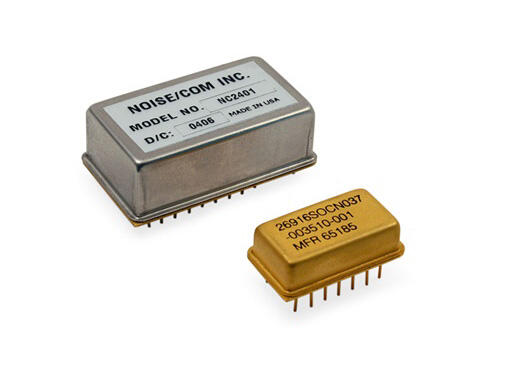
Maury MW - Amplified Noise Module - NC2000-4000 Series
- High-level noise modules mounted on a circuit board
- Modified BW, output power, and flatness specifications
The NC2000 Series amplified noise modules are an excellent choice for high-level noise modules mounted on a circuit board. The NC2000 Series modules are housed in 24, or14-pin dual-inline packages. The NC4000 series modules are housed in a 40-pin module that cover similar noise bands to the NC2000, but have higher crest factor, and 60 dB of TTL controlled attenuation. Modified BW, output power, and flatness specifications are available for these modules. Please consult Noisecom for availability, and appropriate package style.
|
Output |
Minimum Power Output |
Crest Factor |
Flatness |
|---|---|---|---|
|
White Gaussian noise |
25 dB ENR (-143 dBm/Hz) min |
5:1 |
+/-3dB |
Applications
- Dither circuitry for A/D converters
- Communications jamming
- PCIexpress jitter applications
- Built-in test equipment (BITE)
Document
More Product Information
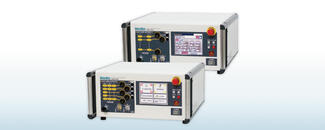
- IEC 61000-4-4 Ed.3 standard compliance.
- Pre-check function is installed. Inspection before testing is now easy.
- Normal mode test support. Taking account of field troubles is possible. (option)
- Utilize an outlet box that simplifies EUT connection. (option)
- Compared with conventional products, the size has become compact. (Approximately 67% by volume)
- Easy to understand Panel display reduces mistakes in connecting power cables.
- Software control with Windows. (option)
- Next calibration date can be notified. (Windows software only)
- Employ LCD screen with multi-language support and enhanced operability.
- Maximum output voltage of 5 kV and maximum pulse frequency of 2 MHz allow you to test above the standard test level.
- CDN capacity is increased to single phase type AC 240 V 20 A, single and three phase type to AC 600 V 63 A, supporting wider range of EUT.
- Large capacity CDN (100 A or 150 A) option available for Injection test on various EUT.
- Using coupling clamps, EMS probe kits, you can test the signal lines and evaluate the noise immunity on the PCB. (option)
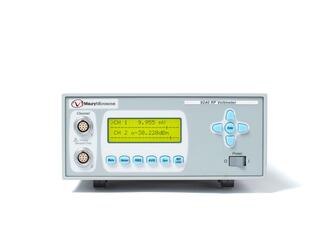
- Dual-channel and differential voltage measurements
- 1% accuracy at full scale
- True RMS response below 30 mV
- Optional low-frequency probe for measurements from 10 Hz to 100 MHz
- DC recorder output
- IEEE-488 interface standard, RS-232
The 9240 series is the latest addition to the popular 9200 series of RF voltmeters. It combines accuracy, smart probes, and operator features that have never before been available in its price range. It is simple to use on the bench, and comprehensive enough to integrate into an ATE system. Boonton’s proven voltage probes directly measure from 200 μV to 10 V with usable indication as low as 50 μV and have true RMS response below 30 mV.
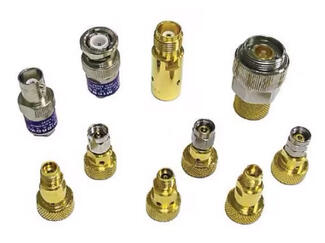
- Calibration-grade metrology standards
- Used for VNA calibration and/or calibration validation
Shielded, coaxial opens are used in the calibration of vector network analyzers to provide a nominal 180° phase offset from a compatible reference short over a wide range of frequencies. At these frequencies, open circuit terminations are inherently imperfect. Shielding the open essentially eliminates radiation loss, but creates a residual frequency-sensitive capacitance. An accurate knowledge of the open’s effective capacitance is essential to an accurate calibration of the analyzer. Maury opens are characterized for effective capacitance versus frequency by means of a fourth order polynomial curve fit, and the nominal capacitance coefficients are provided with each unit.
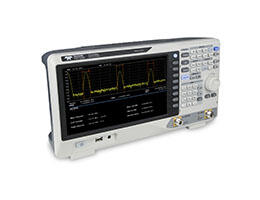
- All Digital IF technology
- 10.1” WVGA (1024 x 600) Display
- Frequency range from 9 KHz up to 3.2 GHz
- -161 dBm/Hz Displayed Average Noise Level (Typ)
- -98 dBc/Hz @ 10 khz Offset Phase Noise (Typ)
- Total Amplitude Accuracy < 0.7 dB
- 1 Hz Minimum Resolution Bandwidth (RBW)
- Comes with Preamplifier
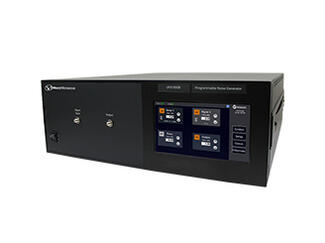
- Output White Gaussian noise
- Output power up to +30 dBm
- 127 dB of attenuation; 0.1 dB step size
- Units > 2 GHz have total attenuation of 79.9 dB
- Low distortion signal path
- Power 115 VAC, 60 Hz
- Noise attenuator accuracy: ±0.2 dB or 0.5% at 1 – 500 MHz ±0.2 dB or 1% at 0.5 – 1.0 GHz ±0.3 dB or 2% at 1 – 2 GHz
- Standard connectors SMA female
- 7” touch screen display
- Dimensions: 17.25 in. wide x 6.50 in. including feet, high x 19.50 in. deep
- Removable hard drive for added security
- Operating Temperature: -10° to +65°C
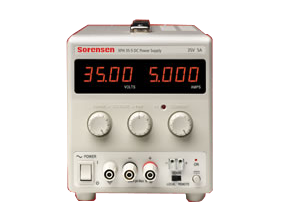
- Low noise
- Excellent line⁄load regulation
- Coarse and fine voltage controls
- Constant voltage or constant current operation with automatic crossover and mode indication
- Individual ON⁄Off switch per output (not including fixed output)
- Switchable 3.3V⁄5V output on triple output model
- Switchable remote sense (XPH 1810 and XPH 4210 models)
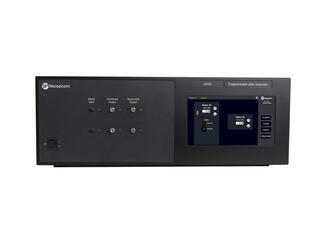
- Ultra-low distortion signal path
- Standard connectors SMA female
- 7” touch screen display
- Dimensions: 17.22 in. wide x 6.30 in. including feet, high x 19.5 in. deep
- Fold-down feet for bench top use
- Power 115 VAC, 60 Hz
- Operating Temperature: -10° to +65°C
- Differential inputs and outputs
- Multiple differential inputs and outputs

Reproduces transient voltage surge phenomena generated in a vehicle and evaluates the immune resistibility of DUT against the surge. The output waveforms are five as high-repeating pulse, giant pulse, field decay pulse, trapezoidal waveform + high-repeating pulse and high repeating pulse + giant pulse.
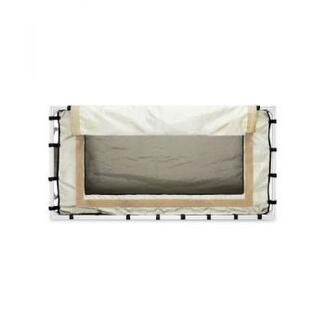
The TBST line of shielded tents is designed to suppress interference from ambient noise when carrying out EMC pre-compliance measurements with sizes of 200 cm x 100 cm x 100 cm, 124 cm x 64 cm x 60 cm or 86 cm x 48 cm x 48 cm. The 200 cm and 124 cm tent can accommodate any Tekbox pre-compliance test equipment such as LISNs or TEM-cells. The 86 cm tent will fit the TBTC0/1/2 and all our LISN.

Maury Microwave
Website
Maury Microwave is a pioneering leader in the design and manufacture of precision RF and Microwave calibration, test & measurement, and modeling solutions that are powering global efforts toward a more secure, more connected, future.
Maury Microwave offers Measurement and Modeling Device Characterization Systems and Services including nonlinear passive, active and hybrid-active fundamental and harmonic load pull, non-50Ω X-Parameter modeling, pulsed IV Pulsed s-parameters and compact transistor modeling, and patent-pending ultra-fast/accurate noise parameters.