
You design the future. We help you make it happen.
Calibration Standards
Products
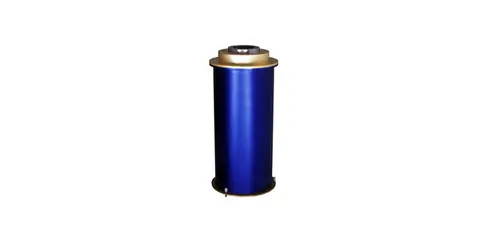
- Expandable frequency range from 18 to 325 GHz
- 2 to 3 times better accuracy
- Automatic Nitrogen purge eliminates helium equipment
- Primary calibration standard
- Radiometer reference source
- SATCOM earth station conformance verifications
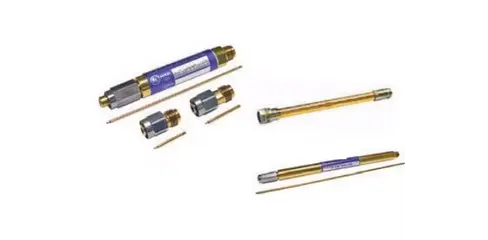
- Calibration-grade metrology standards
- Used for VNA calibration and/or calibration validation
Coaxial air lines are air-dielectric transmission lines with highly accurate dimensions that can be used as fundamental impedance standards in measurement and calibration applications, and may also be used to establish reference positions for measurements.
Bead supported air lines offer greater convenience and easier connections (the center conductor is automatically aligned by the dielectric bead for easy connection); beadless air lines offer better impedance and electrical length accuracies, as well as lower VSWR (the center conductor floats free in the air line body, and the male connector nut is retractable to facilitate insertion of the center conductor contact before the thread- on connection tightened.
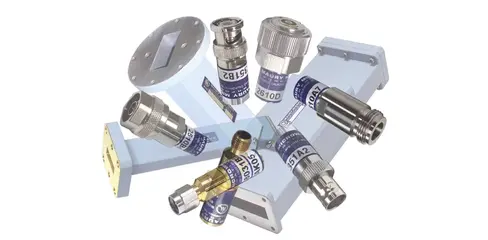
- Calibration-grade metrology standards
- Used for VNA calibration and/or calibration validation
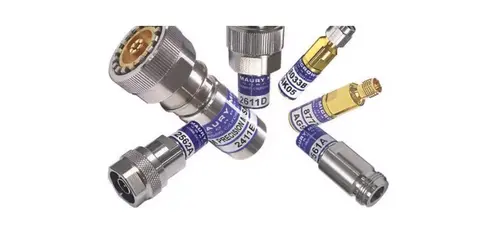
A precision fixed termination (or load) consists of an immovable, (fixed) termination which, when mated to the end of a trans-mission line or cable, absorbs nearly all of the signal energy traveling toward it. An ideal “matched” condition exists when a termination with an impedance value of Z0, is connected to the end of a transmission line or cable that also has a characteristic impedance of Z0. Such an ideal “matched” condition (one with no mismatch between the termination and its mated line or cable) is critical if a voltage standing wave ratio (VSWR) of 1.0:1 is to be achieved in a system with a 50 or 75 ohm impedance value. Simply put, the more closely the 1.0:1 ratio is approached, the more accurate the measurements that can be made from a system.
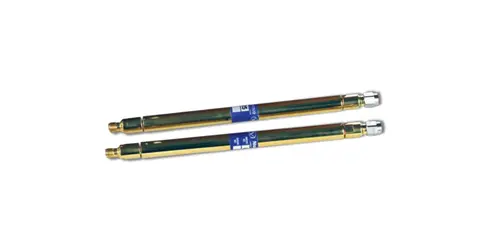
- Calibration-grade metrology standards
- Used for VNA calibration and/or calibration validation
Maury mismatch airlines have been designed as verification standards to be used in VNA calibration validation. Each mismatch airline is provided with factory S-parameters data that can be compared with user-measured S-parameters for VNA calibration validation. Measurement uncertainty is also provided, and uncertainty boundaries can be used for definitive calibration validation when used in conjunction with MT940B Insight Real-Time Uncertainty Add-On.
- Calibration-grade metrology standards
- Used for VNA calibration and/or calibration validation
Precision standard mismatches are fixed coaxial terminations, which are used to introduce a known VSWR into a 50 ohm transmission system. These mismatches are extremely useful in a wide variety of applications and are quick and easy to use. They can be used to calibrate swept reflectometers, verify network analyzer calibration, establish impedance references in TDR measurements.
- Calibration-grade metrology standards
- Used for VNA calibration and/or calibration validation
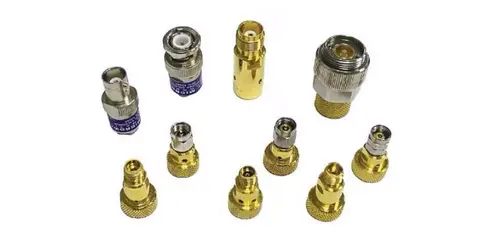
Shielded, coaxial opens are used in the calibration of vector network analyzers to provide a nominal 180° phase offset from a compatible reference short over a wide range of frequencies. At these frequencies, open circuit terminations are inherently imperfect. Shielding the open essentially eliminates radiation loss, but creates a residual frequency-sensitive capacitance. An accurate knowledge of the open’s effective capacitance is essential to an accurate calibration of the analyzer. Maury opens are characterized for effective capacitance versus frequency by means of a fourth order polynomial curve fit, and the nominal capacitance coefficients are provided with each unit.
- Calibration-grade metrology standards
- Used for VNA calibration and/or calibration validation
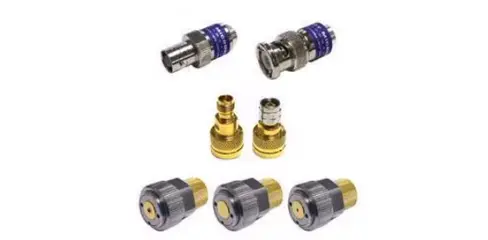
Fixed flush and fixed offset short circuit terminations (shorts) are used to establish reference planes in transmission systems and as key elements in the calibration of vector network analyzers (VNAs). Offset shorts can be used for banded calibrations of VNA. Those with the longest offset are often used to evaluate the calibration effectiveness of a VNA by measuring the effective source match after calibration.
- Calibration-grade metrology standards
- Used for VNA calibration and/or calibration validation
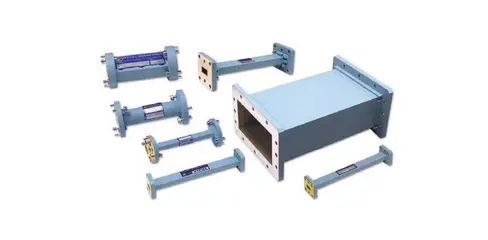
Precision waveguide sections are a useful component in the VNA calibration validation process, and can also be used as sample holders for material measurements.