
You design the future. We help you make it happen.
Products
Displaying 529 - 540 of 804
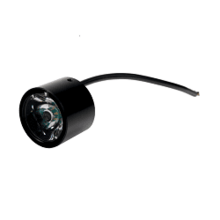
Extremely bright, compact and reliable
Chip-on-board LED technology
Seamless integration and mounting
SpecBright Spot Lights utilize Chip-on-Board LED arrays to provide extremely bright, uniform light from a compact form factor. These lights are designed for easy installation and the many options available make them an ideal solution for many applications.
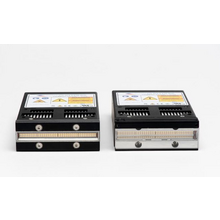
UV curing is a photopolymerization process in which UV energy is used to solidify liquids. UV LED curing systems are now the technology of choice across a wide range of applications including printing, 3D printing, coatings, and adhesives due to the inherent value of an LED solution. They offer vastly improved lifetimes, reduced maintenance costs, significant energy savings, and with no ozone emissions or mercury content, offer more benefits than traditional technologies. In addition, the “cold cure” offered by LED-based systems is ideal for heat-sensitive substrates or thin films.

UVC-based disinfection, often called, Ultraviolet germicidal irradiation (UVGI), is the use of ultraviolet (UV) light to kill or inactivate viral, bacterial, and fungal species. When UV-C light is incident upon the target, the incident photons are absorbed by DNA or RNA, causing inactivation of the DNA or RNA double helix strands through the formation of molecular lesions. When enough of these lesions are created, the replication process is disrupted, and the cell cannot replicate. Absorption by proteins can lead to the breakdown of the organism’s cell walls causing the cell to die. For most commercial applications, replication prevention is sufficient.
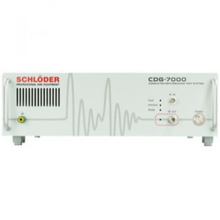
See "Specifications & Details" tab for more information.
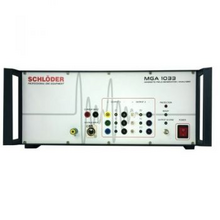
The compact magnetic field generator and analyzer MGA 1033 allows susceptibility tests against magnetic fields from DC to 250 kHz according to the standard EN 55103-2 and their measurement according to EN 55103-1. In addition, EMC tests are possible according to various standards such as automotive, avionic and MIL-STD.; Generation of magnetic fields from DC to 250 kHz; Field strength up to 1000 A/m; EN 55103-1/2, MIL-STD 461, Automotive etc.; Accessories: Loop sensors, Helmholtz coils etc.;
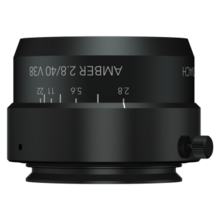
Image circle: 43.2 mm - 82 mm
4 focal lengths: 40 mm - 100 mm
Homogeneous imaging performance across the entire image field
Very low distortion and high resolution
V38-Mount, compatible to theV38 mounting system
Initial apertures: F2.8 - F5.6
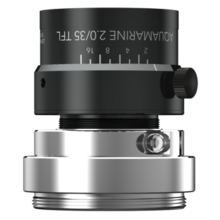
1.3" (24 mm) max. sensor size
C-Mount lens and TFL-Mount lens available
2 focal lengths: 28 mm and 35 mm
Initial aperture: F2
Ruggedized version for 28 mm lens
Motorized iris available for 28 mm lens
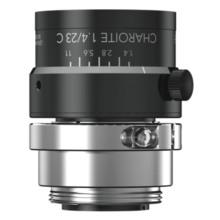
SWIR (800-1800 nm) optimized
2/3" (11 mm) max. sensor size
C-Mount lens
Focal length: 23 mm
Initial aperture: F1.4
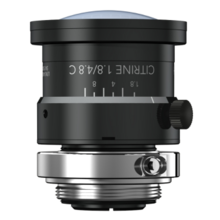
2/3" (11 mm) max. sensor size
C-Mount lens
6 focal lengths: 4.8 mm - 35 mm
Initial apertures: F1.4 - F1.9
Ruggedized and stabilized versions available
Motorized iris available
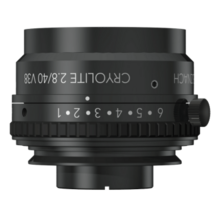
SWIR (800-1800 nm) optimized
43.2 mm max. sensor size
Focal length: 40 mm
Initial aperture: F2.8
Compatible to the V38-Mount System
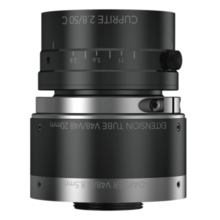
SWIR (800-1800 nm) optimized
25.4 mm max. sensor size
Very high resolution down to 2.4µm pixel size
C-Mount lens and V48-Mount lens available
Focal length: 50 mm
Initial aperture: F2.8
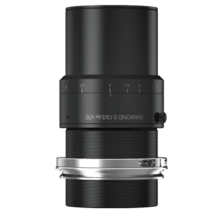
Extremely high resolution down to 3.5µm pixel size
Image circle: 62.5 mm - 82 mm
Optimized for specific magnifications
5 magnifications available: 2.6x - 5.2x
Versions with beamsplitter available
Best azimuth marking
V-Mount for easy installation